This Week in Bone Science · No. 02
Every week we read the new bone research — including the parts the headlines skip.
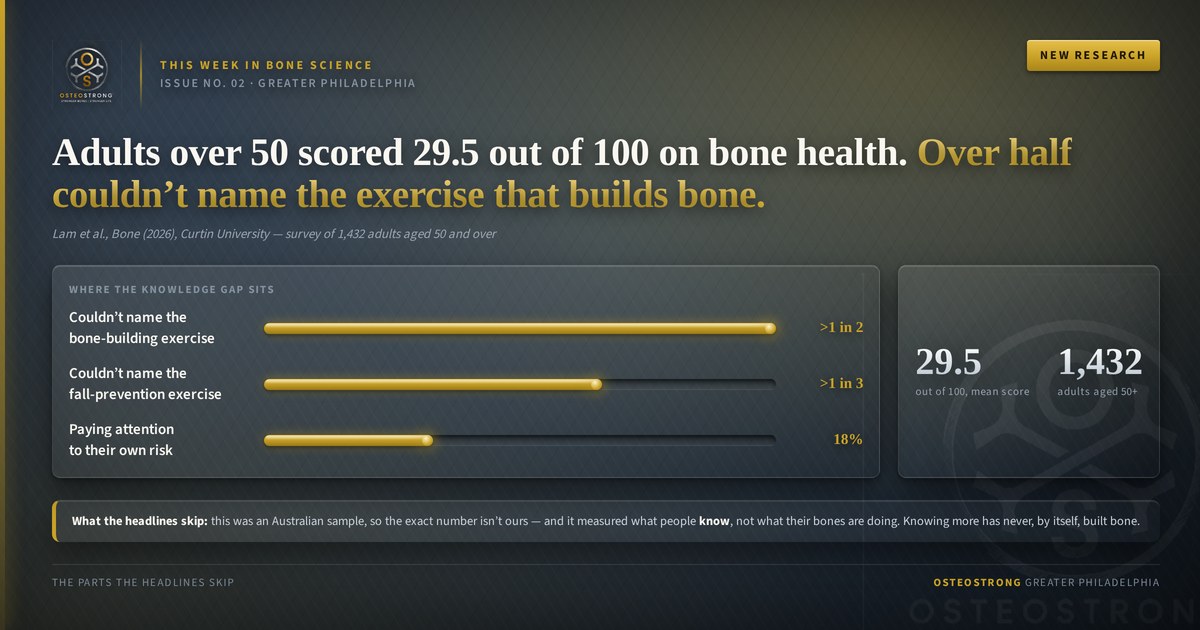
People over 50 scored 29.5 out of 100 on bone health
Researchers at Curtin University asked 1,432 adults aged 50 and over what they know about osteoporosis. The paper is in the journal Bone. The average score was 29.5 out of 100.
The biggest gap wasn’t calcium, and it wasn’t hormones. It was exercise. More than half of participants could not identify which types of exercise — resistance training among them — help protect bone. More than a third could not identify which exercise improves balance and reduces the risk of a fall.
Only 18% said they paid much attention to reducing their osteoporosis risk at all — despite 30% of the women and 13% of the men reporting a family history of it. Men were more than twice as likely as women to score poorly. So were people who were older, had less formal education, or had no family history to prompt them.
What the headlines skip
This was an Australian sample, so 29.5 isn’t a number about your neighbours in Montgomery County. It’s also a cross-sectional survey — it measured what people know, at one moment in time. Nobody’s bone density was measured. Knowing more about bone has never, by itself, built any.
But here’s the part that holds regardless of country: you cannot act on a risk nobody has explained to you. Bone loss has no symptoms until something breaks. If more than half of adults over 50 can’t name the kind of exercise that loads bone, that isn’t a motivation problem. It’s an information problem — and it’s the one we can actually fix.
An AI can now flag hip fracture risk years before it happens
Also published late last month, in PLOS Medicine: Swedish researchers built a machine-learning tool called FRACTURE-ML from national registry data on 3,542,647 people aged 50 and over, of whom 142,327 went on to fracture a hip.
It performed well — an AUC of 0.89 for predicting a fracture one year out, 0.85 at five years. Compared with the current standard of care, which mostly identifies people after their first fracture, it flagged roughly seven times more at-risk people (sensitivity 0.84 versus 0.12).
What the headlines skip
The authors say it themselves — there is no external validation and no implementation study yet. It hasn’t been shown to help a single patient in practice. It uses registry data only, so it knows nothing about smoking, drinking, or whether you exercise. And the extra sensitivity costs specificity: more people flagged means more false alarms.
Still, the direction is clear, and it raises the obvious question. If a model can tell you five years ahead of time, what exactly are you meant to do with those five years?
Prediction isn’t prevention.
That’s the harder half of the problem, and it’s the one nobody’s building an algorithm for: loading the skeleton, holding onto muscle, keeping your balance, and eating enough protein.
Where to start
If that Curtin number bothered you — or if you weren’t sure you’d have scored much better — that’s what Boneprint Academy is for. Tier 1 is free — create an account and start with the first lesson, with every claim cited.
| Open Boneprint Academy |

Ryan Brown, FNLP, BCDFN, AFMCP
Board Certified Functional Nutritionist · Certified Health & Longevity Coach
Founder & CEO, Vital Edge Wellness
Owner, OsteoStrong Greater Philadelphia