This Week in Bone Science · No. 09
Every week we read the new bone research — including the parts the headlines skip.
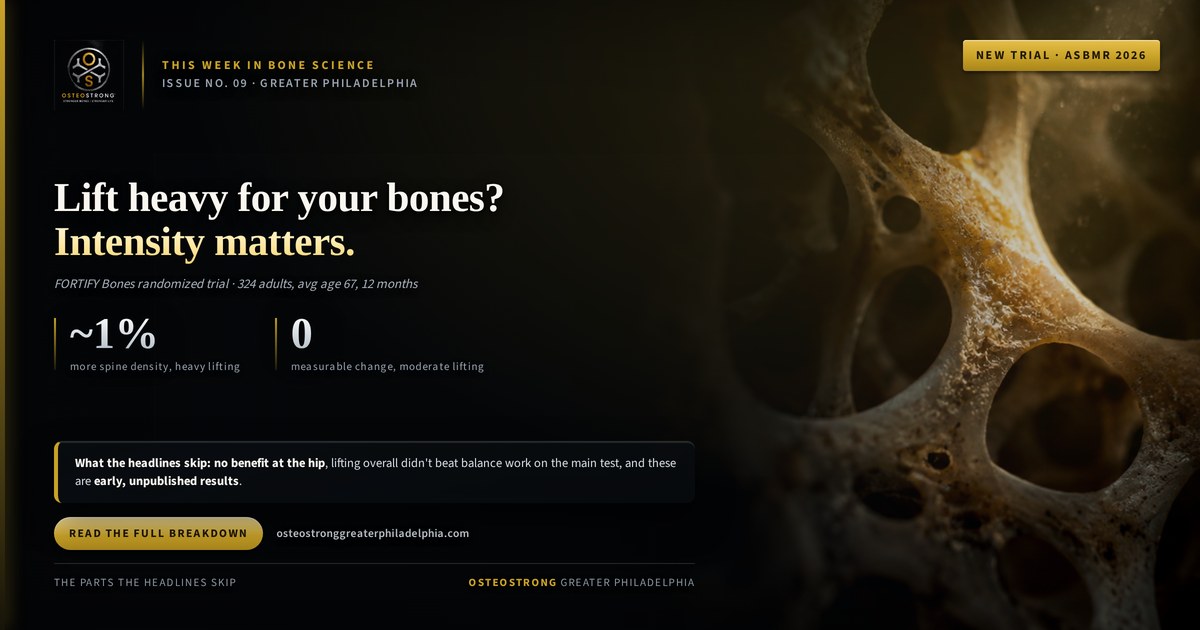
Lift heavy for your bones? Intensity matters.
If you’ve ever wondered whether the weights you lift are heavy enough to matter for your bones, a new Canadian trial has a first answer. It’s called FORTIFY Bones, short for “Finding the Optimal Resistance Training Intensity for Your Bones,” and it was led by Professor Lora Giangregorio at the University of Waterloo. The early results were presented in October at the American Society for Bone and Mineral Research meeting in Boston.
The team followed 324 adults with low bone density for a year. Their average age was 67, and about nine in ten were women. None were taking bone medication. Everyone trained twice a week in one of three groups: posture and balance exercises at home, moderate supervised lifting (about 12 reps, not to failure), or heavy supervised lifting (a weight they could lift only about 6 times). The lifting groups did squats, deadlifts, step-ups, hip thrusts, presses and rows.
The good news
The heavy-lifting group ended the year with spine bone density about 1% higher than both the moderate group and the balance group. That’s a small number, but in a year-long randomized trial in older adults with low bone density, it’s a real signal.
Just as important, heavy lifting was safe in this group. There were some minor, expected aches, but no fractures caused by the exercise. People also stuck with it: 91% came back for their final scans, and attendance ran around 86–92%.
Bone responds to load, not effort. Moderate weights felt like work, but they didn’t move the needle.
Harvard’s Mary Bouxsein, a past president of the bone research society who saw the talk, summed it up: if you’re training for your bones, intensity matters, and the benefits may not show up at every site in the skeleton.
The catches
What the headlines skip
The trial’s main question came back flat. Its headline test compared all lifters together against the balance group, and there was no difference in spine or hip density. The 1% comes from splitting heavy from moderate, which was a planned but secondary comparison.
Nothing happened at the hip. Neither intensity changed hip or femoral-neck density, and hip fractures are the most dangerous ones.
These are early results. They haven’t been published in a journal yet, and the researchers say the exact size of the effect still needs confirming.
It measured density, not fractures. Results on strength, balance, falls and fractures haven’t been reported yet.
Who was in it matters. Most participants were at low fracture risk, mostly White women, and people who already lifted were excluded. Results may differ for people at high risk or already training.
A note on where these numbers come from: the full results aren’t public yet. We read the trial’s registration and its published protocol ourselves. The result figures come from Medscape’s report of the conference presentation.
What to do with this
If you’re training for bone, the load has to be genuinely challenging, and it should be built up gradually with good coaching. Moderate work still has value for strength, balance and confidence, which help prevent falls. But this trial suggests it may not be enough on its own to change bone density. And exercise isn’t a substitute for medication when your doctor recommends it. The effects seen here are smaller than what bone drugs typically produce.
If you want the underlying mechanics — what bone density measures, what it misses, why load is the signal, and how to read your own report — that is what Boneprint Academy is for. 71 lessons, 890 citations, completely free, no signup required.
| Open Boneprint Academy |
Sources.
Haelle T. Only high-intensity resistance training modestly improves lumbar spine bone mineral density. Medscape Medical News, 27 October 2026 (report of FORTIFY Bones results presented at ASBMR 2026).
Giangregorio LM, et al. Finding the Optimal Resistance Training Intensity for Your Bones: protocol for a randomized controlled trial. Physical Therapy 2023. doi:10.1093/ptj/pzad120
ClinicalTrials.gov NCT05541432. Finding the Optimal Resistance Training Intensity For Your Bones (FORTIFY Bones). University of Waterloo.

Ryan Brown, FNLP, BCDFN, AFMCP
Board Certified Functional Nutritionist · Certified Health & Longevity Coach
Founder & CEO, Vital Edge Wellness
Owner, OsteoStrong Greater Philadelphia
