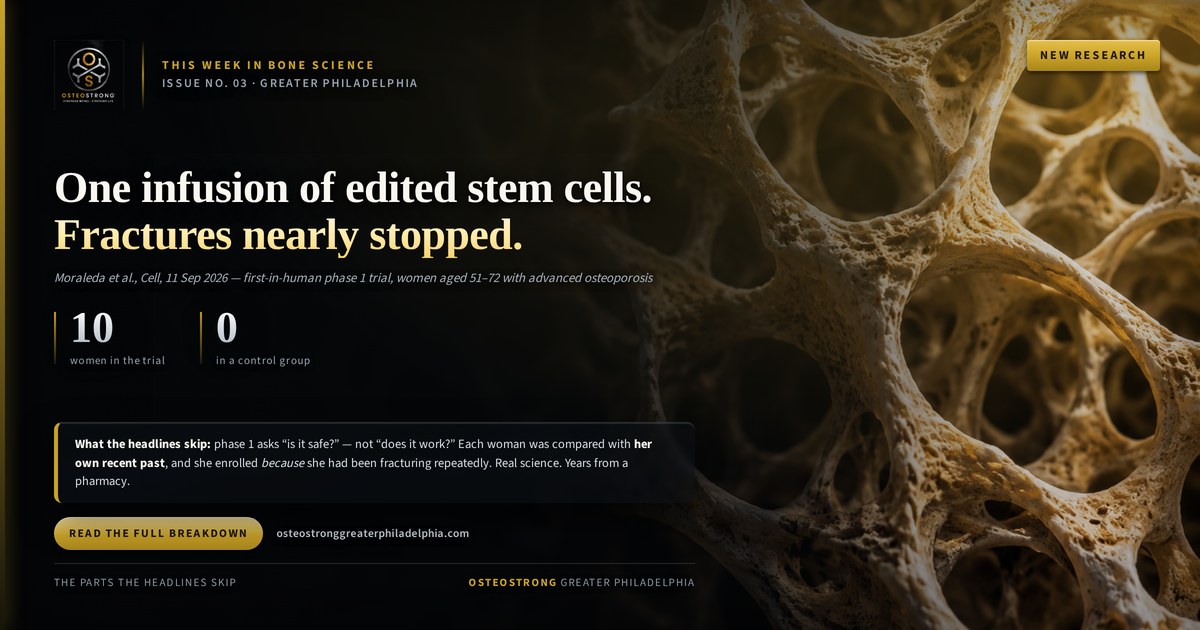
This Week in Bone Science · No. 03
Every week we read the new bone research — including the parts the headlines skip.
“A living medication cut fractures by 94%”
On 11 September, the journal Cell published something genuinely remarkable: ten women with advanced osteoporosis were given an infusion of their own stem cells, and their fractures very nearly stopped.
Here is what the researchers in Murcia, Spain actually did. They drew bone marrow from each woman’s hip and isolated her mesenchymal stem cells — the cells that build bone. Those cells have always had the ability to regenerate bone; the problem is that when you put them in a vein, they don’t go to bone. So the team edited the sugar coating on the outside of the cells, which is the part the bloodstream reads as an address label. Then they infused them back. Once.
The women were 51 to 72 years old, with advanced disease and a history of repeated fragility fractures. They were followed for two years under the trial protocol, and then for more than three further years for fractures and safety. There were no serious adverse events. Bone-formation markers rose. Bone biopsies showed more bone tissue. Imaging showed gains in the spongy trabecular bone inside the skeleton. And, as reported in the coverage of the trial, fractures fell from roughly eight a year across the group in the two years before the infusion to about half of one a year in the two years after.
What the headlines skip
This was a phase 1 safety trial in ten people. One arm, no control group, no randomisation, no blinding, one hospital. The 94% figure compares each woman with her own recent past — and she was enrolled because she had just been fracturing repeatedly, which is precisely the situation in which the rate tends to fall on its own. Every participant was a woman with advanced osteoporosis, so none of it speaks to osteopenia or to prevention. And the trial’s senior author holds the assigned intellectual property on the cell-editing platform — disclosed in the paper, as it should be, and worth knowing.
None of that makes it unimportant. Phase 1 trials are supposed to be small; that is their job. This one answered its question — the procedure appears safe and feasible — and produced a signal strong enough to justify the much larger, controlled trial that has to come next. If it holds up, it will matter enormously.
Phase 1 is “is it safe?” Nobody has yet run the trial that asks “does it work?”
Which brings us to the part that got lost between the paper and the headline. A therapy at this stage is, realistically, years from a pharmacy — and it involves a bone marrow harvest and a cultured cell product made individually for you. It is not a decision in front of you this year. What you do with your skeleton between now and then still is.
Meanwhile, the BMJ looked at 124 exercise trials
Two days earlier, on 9 September, The BMJ published a large analysis asking a much more immediate question: what kind of exercise, and how much of it, actually protects bone after 40? The researchers pooled 124 randomised trials covering 18,429 people.
Exercise worked — it slowed the age-related decline in bone density. The rankings, though, are not what most people expect. Brisk walking or jogging came out on top for density at the spine and hip, with combined aerobic-and-resistance exercise close behind at the spine. Mind-body exercise — tai chi and similar — did well at the femoral neck. And the dose curve was an inverted U: benefit appeared at roughly 400 to 600 MET-minutes a week, about two to three hours of brisk walking, and then flattened. More was not better.
In a separate fracture analysis of 26 trials and 11,132 people, mixed aerobic exercise and mind-body exercise were associated with fewer fractures. Other modalities were neutral.
What the headlines skip
Almost nothing in this analysis is high-certainty evidence. The authors rate most of their own estimates low to moderate, and say the findings offer only “cautious support” for putting exercise doses into guidelines. The absolute effects are 0.01 to 0.02 g/cm² of bone density — real, and small. A ranking built from low-certainty inputs is not a league table, and it should not be read as “walking beats lifting.” It is also worth knowing that MET-minutes is a cardiovascular measure: it captures how hard your lungs work, and cannot represent force, loading rate, or strain — the things bone actually responds to. And one more thing we should say out loud: a different meta-analysis of 162 trials, published in the journal Bone last month, put the plateau closer to 1,100 MET-minutes a week. Two large 2026 analyses, two different answers on dose.
The tai chi finding deserves a sentence of its own, because the mechanism is almost certainly not density. Balance training doesn’t thicken your femur. It stops you hitting the floor. Roughly one in three adults over 65 falls each year, and that is the step in the chain where most hip fractures are actually decided.
Bone density is one line of defence. Not falling is the other, and it is the one people train least.
Where this leaves you
Two papers, two weeks, two honest conclusions. An edited-cell therapy that may one day rebuild bone has cleared its first safety hurdle in ten patients. And the largest recent look at exercise says that moving with intent, a few hours a week, measurably slows the decline — modestly, on evidence that is still not strong.
Nobody gets to promise you more than that yet. Anybody who does is selling something.
If you want the underlying mechanics — what bone density measures, what it misses, why load is the signal, and how to read your own report — that is what Boneprint Academy is for. 71 lessons, 890 citations, completely free, no signup required.
| Open Boneprint Academy |

Ryan Brown, FNLP, BCDFN, AFMCP
Board Certified Functional Nutritionist · Certified Health & Longevity Coach
Founder & CEO, Vital Edge Wellness
Owner, OsteoStrong Greater Philadelphia